Franz
Franz is one of the two policemen who arrest Josef K. at the start of The Trial, a junior officer whose actions and subsequent punishment reveal the arbitrary, corrupt, and inescapable nature of the Court. He and his colleague Willem are the first representatives of the judicial system K. encounters, and their petty venality, combined with their later brutal punishment, establishes the pattern of humiliation and futility that defines K.'s entire ordeal.
Identity and Role
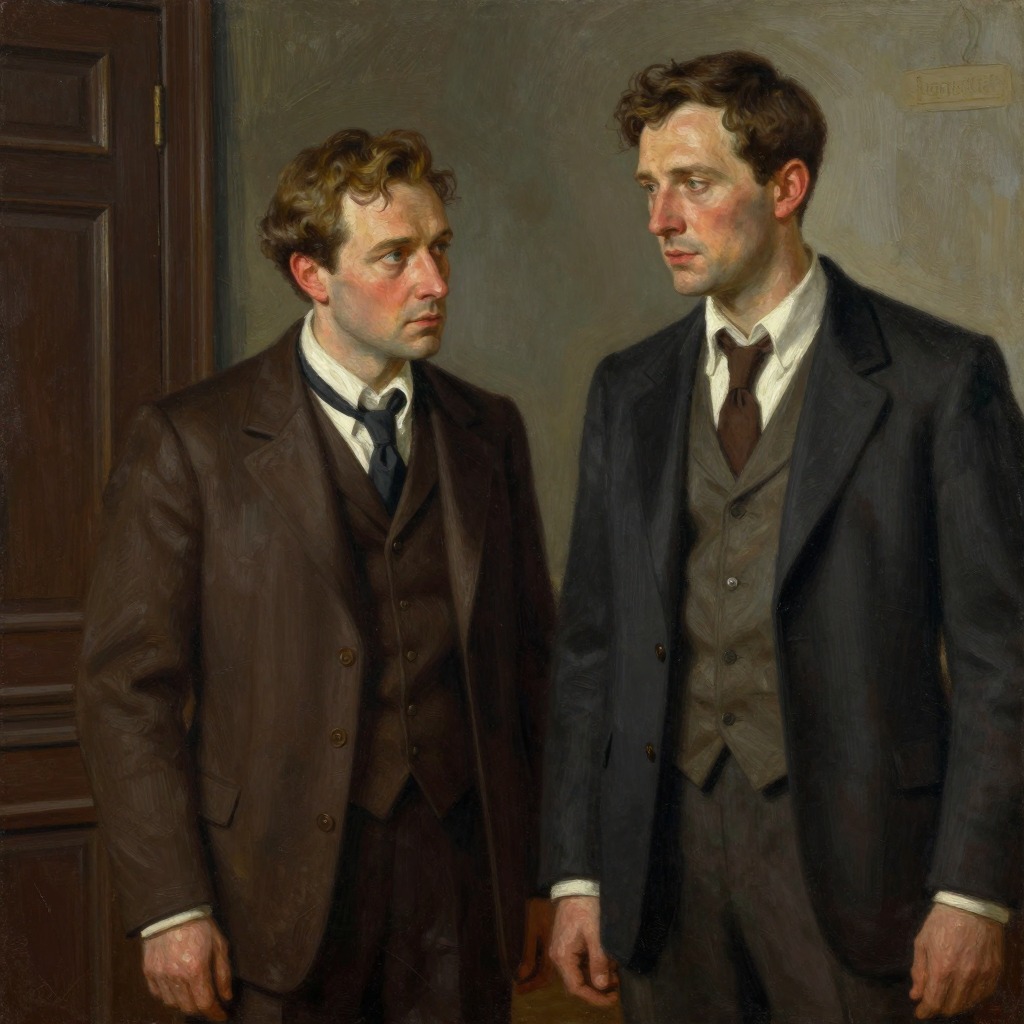
Franz is a low-ranking police officer, described as slim but firmly built, dressed in a practical but ambiguous black uniform. He first appears in K.'s bedroom on the morning of the arrest, entering in response to K.'s bell. He is immediately subordinate to his partner Willem, whom he addresses deferentially. When K. demands to see Mrs. Grubach, Franz and Willem physically restrain him, feeling his nightshirt and insisting he change into a black coat. They explain that they are merely "junior officers" who "hardly know one end of an ID card from another," their only duty being to keep K. under observation for ten hours a day. Franz's role is that of a functionary, a cog in a vast, incomprehensible machine.
Actions During the Arrest
During the arrest, Franz is more passive than Willem, but he participates in the intimidation. He holds a cup of coffee and looks at K. in a way that is "probably meant to be full of meaning but could not actually be understood." He later joins Willem in examining K.'s clothes and suggesting they be confiscated. When K. argues that he does not know the law, Franz interjects, "Look at this, Willem, he admits he doesn't know the law and at the same time insists he's innocent." This comment, while seemingly logical, is a hollow application of the Court's twisted logic. Franz also delivers the curt, military shout, "The supervisor wants to see you!" which startles K. His behavior is that of a minor official who follows orders without understanding their purpose, embodying the mindless bureaucracy of the Court.
The Whipping and Its Aftermath
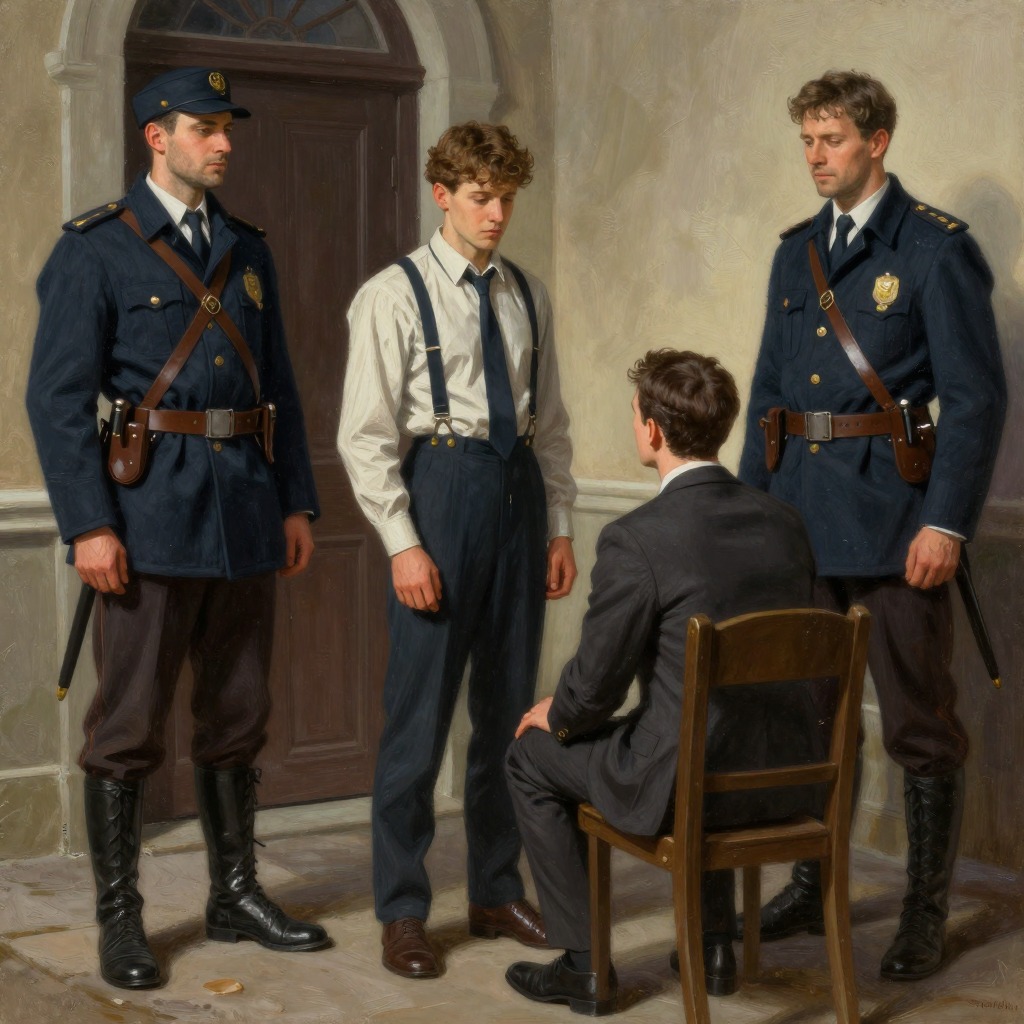
Franz's most significant appearance occurs in the chapter "The Whip-man." Weeks after the arrest, K. discovers Franz and Willem in a junk room at the bank, about to be flogged by a whip-man because K. had complained about their conduct to the examining judge. Franz is terrified, hiding behind Willem and pleading with K. for mercy. He claims he is less sensitive than Willem and that his record is clean, blaming Willem for leading him astray. He even invents a story about his bride waiting for him at the bank entrance to elicit sympathy. When K. fails to bribe the whip-man, Franz is brutally beaten. His scream is described as "long and irrevocable," sounding "not from a human being but from an instrument that was being tortured." K. shoves him, causing him to fall unconscious, but the beating continues. The next day, K. finds Franz and Willem still in the junk room, still undressed, still awaiting punishment, as if the scene is frozen in time. K. slams the door in horror, realizing the Court's punishment is relentless and inescapable.
Significance and Thematic Role
Franz is a flat character, defined entirely by his function within the Court's apparatus. He is not an individual but a type: the petty, corruptible, and ultimately disposable official. His fate demonstrates that the Court's power is not limited to the accused; it also consumes its own servants. Franz's attempt to shift blame and his desperate plea for mercy reveal the moral cowardice that the system breeds. His punishment, which K. inadvertently triggers, becomes another source of K.'s guilt and anxiety, showing how even a well-intentioned complaint can have unforeseen and brutal consequences. Franz's final, agonized scream and his perpetual, unresolved punishment underscore the novel's central theme: the arbitrary, all-consuming, and ultimately meaningless nature of the judicial process.